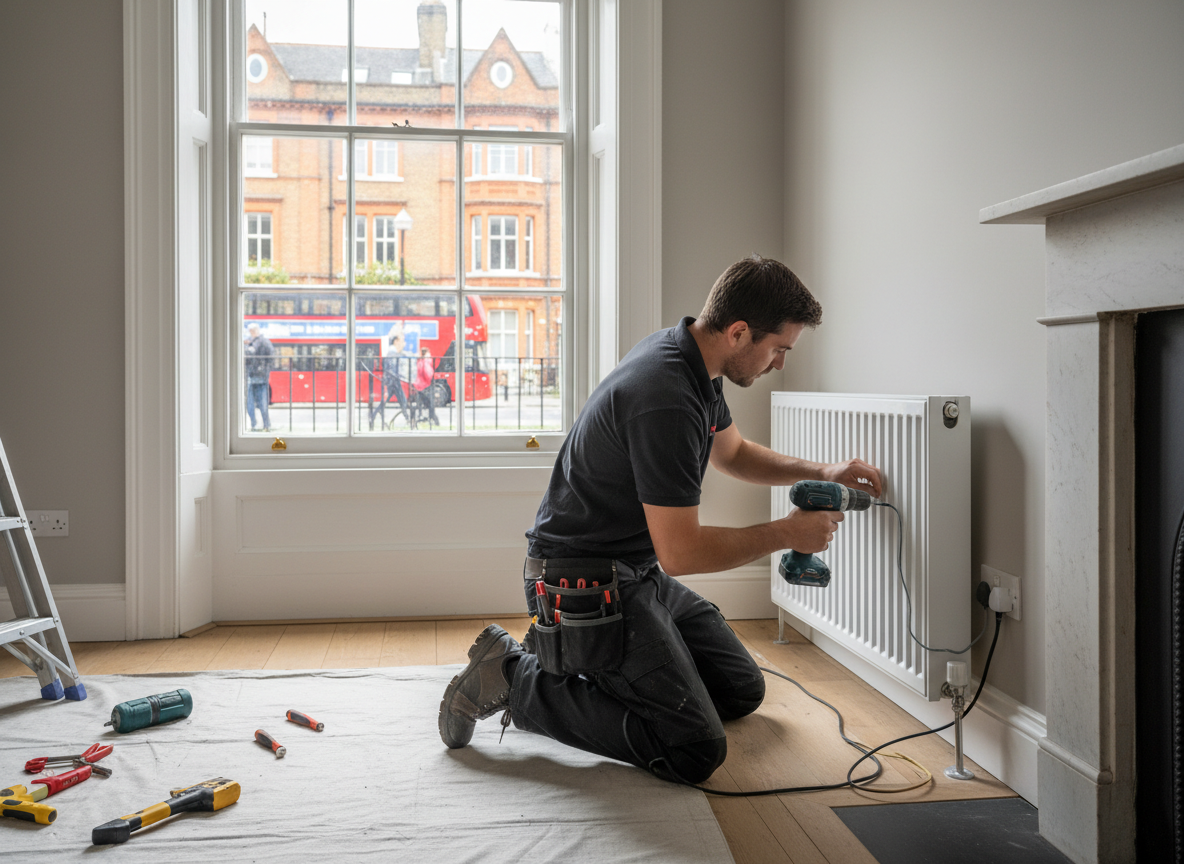
London’s older housing stock, especially Victorian terraces and Edwardian semis around Westminster and Southwark, often has single-phase supplies and aged consumer units that cannot safely carry the load of new electric radiators. Before any installation we carry out a full load assessment and check whether a consumer-unit upgrade or dedicated radial circuit is required to meet current IET wiring regulations. Damp basements and solid walls common in SE1 properties also affect radiator placement and fixing methods, so we use appropriate wall anchors and allow for thermal bridging that can reduce efficiency if ignored.
Electric radiators installed in flats above shops or in converted warehouses near Waterloo frequently encounter restrictions on external cabling routes and fire-rated ceilings. We route cables through existing conduits where possible and fit low-profile models that sit within alcoves without encroaching on limited floor space. In winter, when temperatures drop and wind-driven rain hits exposed elevations along the Thames, correctly sized radiators with built-in thermostats prevent both under-heating and excessive running costs that occur when oversized units short-cycle.
Many homeowners in Greater London request electric radiators as a solution when gas is unavailable or when they want room-by-room control. We always verify that the chosen models carry the necessary BEAB or CE marks and that any smart controls integrate with existing Wi-Fi without creating new interference issues in densely packed streets. Edge cases include listed buildings where visible trunking is prohibited, requiring surface-mounted wireless units or internal chasing that must be approved by the local conservation officer before work begins.
Technician insight
In London, the thing that catches most people out with electric radiator installer near me is the state of the consumer unit in Victorian terraces around Westminster and Southwark. Many still run on old rewireable fuses or early MCB boards that cannot handle multiple modern heaters without tripping or overheating the tails. We always check this first because a quick radiator swap can turn into a full board upgrade once we open the cupboard.
Southwark Terrace Overload
A homeowner in a three-storey Victorian terrace near Westminster Bridge Road called after their new electric radiators kept tripping the main breaker. We found the existing 1960s consumer unit feeding four heaters on a single 20 A circuit. We installed a new dedicated 32 A radial to the top floor, fitted two low-wattage slimline radiators with individual electronic thermostats, and left the system running without trips through the first cold snap.
How it works
- 1
Site Survey And Load Check
We attend the property in London to inspect the existing consumer unit, earthing arrangement and available circuits, noting any constraints from solid walls or shared risers.
- 2
Design And Product Selection
We calculate heat loss room by room, accounting for window orientation and insulation levels typical of SE1 stock, then recommend correctly sized radiators and controls.
- 3
Installation And Testing
New dedicated circuits are installed where needed, radiators are mounted and wired, and the system is tested for earth continuity and correct operation of thermostats and timers.
- 4
Handover And Documentation
We provide the homeowner with operating instructions, a circuit schedule and advice on seasonal settings that suit London’s mild but damp winters.
Pricing
Quotes issued after on-site survey; final cost depends on circuit upgrades, number of radiators and access conditions in older London buildings.