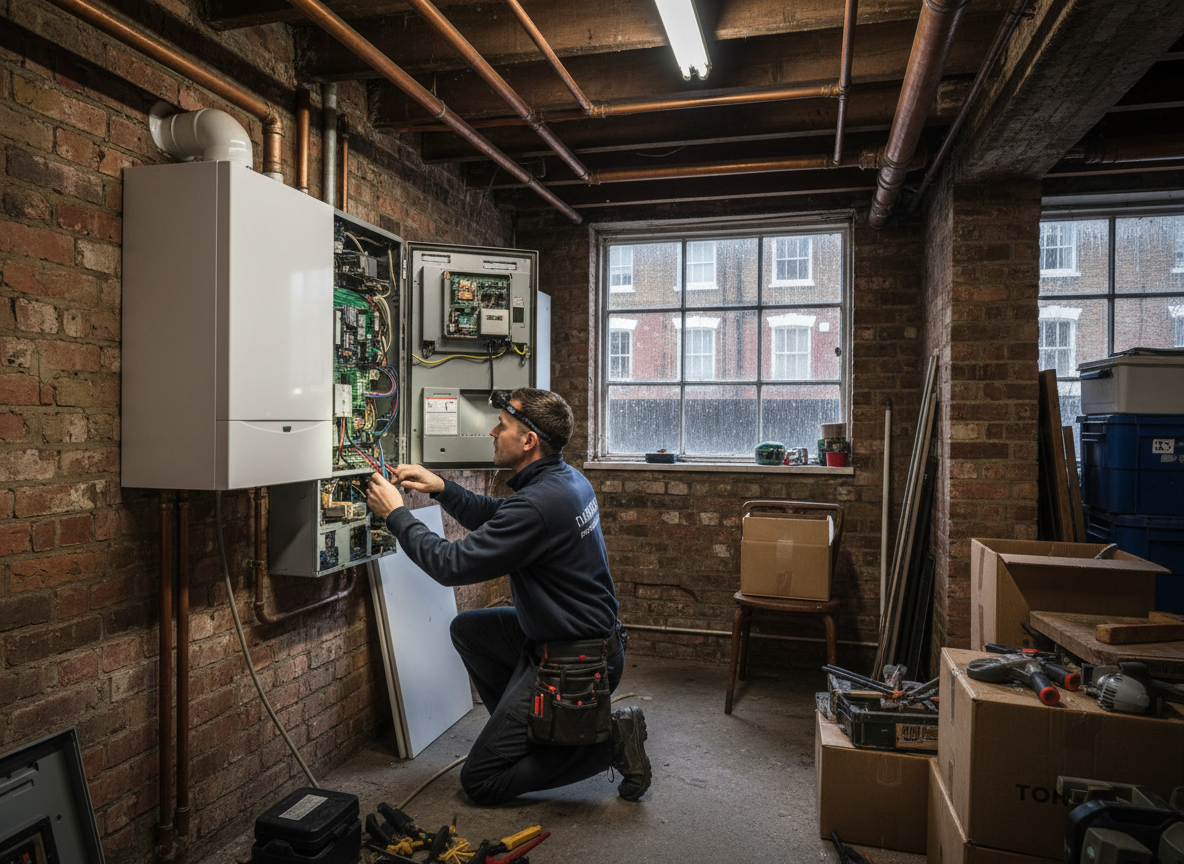
London's housing stock, especially pre-1919 terraces in Westminster and Southwark, often features original wiring that struggles under modern electric heating loads. When an emergency call comes in, the first check is always the consumer unit and any hidden junction boxes behind skirtings where damp from the Thames basin has caused corrosion. Older properties also have single-skin walls that lose heat quickly once temperatures drop below freezing, so a failed panel heater or storage heater can leave rooms uninhabitable within hours.
We carry common elements, thermostats and time switches for both night-storage and direct-acting systems that are still widespread in Greater London flats. Edge cases include properties with listed-building restrictions where surface trunking must be used instead of chasing brickwork, and conversions where multiple meters feed one flat. All work follows current Part P requirements; we isolate circuits at the main board and test earth continuity before re-energising.
Winter storms in the capital frequently bring power surges that damage heating controls. Homeowners sometimes attempt temporary fixes with extension leads or bypassed timers, which we always replace with properly rated, fused connections. After repair we leave the system on a test cycle so the customer can verify even heat distribution before we leave site.
Technician insight
In London the thing that catches most people out with emergency electric heating repair is the state of the original wiring in Victorian terraces around Westminster and Southwark. Damp from the river basin corrodes junction boxes hidden behind skirtings, so what looks like a simple element failure often turns into a full rewire of the final circuit before the heater can be restored.
Failed night-storage heater in a Westminster conversion
The customer reported no heat from a 1980s storage heater on the first floor of a converted Georgian house near Westminster Bridge Road. We found the supply cable had overheated at a corroded junction box behind the skirting. The circuit was isolated, the junction replaced with heat-resistant cable, and the heater reconnected and tested on boost.
How it works
- 1
Take the call and dispatch
Our 24/7 line logs the address, heating type and symptoms, then routes the nearest van from the SE1 base to the property.
- 2
Isolate and diagnose on site
We isolate the circuit, inspect the consumer unit, elements and controls, then locate the fault using clamp meters and insulation testers.
- 3
Carry out repair or replacement
Faulty parts are swapped using stock carried in the van; new connections are made with heat-resistant cable and proper earthing.
- 4
Test and hand over
The system is run through a full cycle, earth readings recorded, and the customer shown the repaired area before we leave.
Pricing
Upfront quote given on site once the fault is identified; parts and labour charged separately.