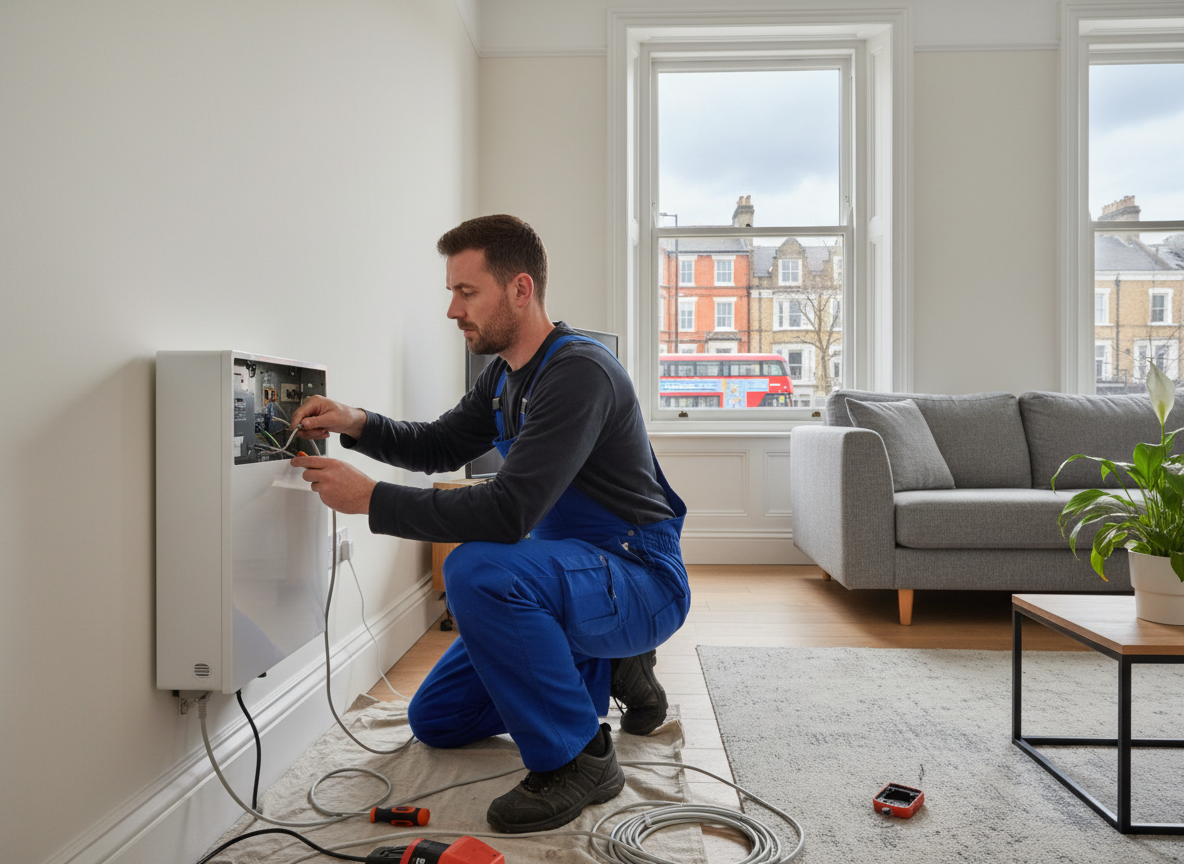
London’s Victorian and Edwardian terraces around Westminster and Southwark frequently present single-phase supplies that struggle with the draw of modern storage heaters. Installers must first verify cable sizes and consumer unit capacity before any new unit goes in, as many properties still rely on 1960s wiring runs that overheat under sustained load. Damp basement conversions common near the Thames also require heaters mounted on treated timber battens to prevent moisture tracking into the casing.
Storage heaters installed in purpose-built flats off Westminster Bridge Road often need time-delay relays to work with economy tariffs that finish at 7am. Incorrect relay settings leave residents paying peak rates for the first two hours of the day. In these buildings the concrete floors act as heat sinks, so units must be sized 20 percent larger than the calculated room volume to maintain comfort once the off-peak period ends.
Edge cases include listed buildings where external trunking is prohibited; cables must be chased into walls and made good to conservation standards. Roof voids above top-floor flats in the SE1 postcode regularly exceed 40 °C in summer, so any new heater controller must be rated for high ambient temperatures or it will trip prematurely during the summer storage period.
Technician insight
In London, the thing that catches most people out with storage heater installation is the 60 A or 80 A main fuse still fitted in many 1930s mansion blocks near Westminster Bridge Road; the new heaters trip it within the first week of winter because the incoming tails cannot carry the sustained load.
Storage Heater Upgrade in a Westminster Terrace
The client’s 1920s terraced house had three 1960s storage heaters that no longer held charge overnight. We found the original 6 mm² tails feeding a 60 A fuse and discovered charred insulation inside the consumer unit. New 10 mm² tails and a 100 A fuse were fitted, three 2.5 kW modern storage heaters installed on separate circuits, and the system commissioned on the economy tariff. The house now maintains temperature through the morning without tripping the supply.
How it works
- 1
Site Survey
Check existing consumer unit rating, cable routes and wall construction in the specific London property.
- 2
Load Calculation
Measure room volumes and account for single glazing and solid walls typical of pre-1919 terraces.
- 3
Supply Upgrade If Required
Install new tails or split load board where the existing 60 A service cannot support the heater bank.
- 4
Installation and Commissioning
Mount units, connect to economy tariff timer, test charge and discharge cycles before handover.
Pricing
Cost depends on whether the consumer unit needs upgrading and the number of units; we provide a fixed quote after the survey.